Tuesday, April 13, 2010

1st on Oak Tasting - 2009 Syrah - Day 171

Had our first chance to taste the wine. No surprises here, it's still young, but each of the batches had started to move in a different direction. It's exciting to see each batch of wine start to take on a character of its own.

For this tasting, I had the help of my lovely assistant, Sara. She was gracious enough to man the wine thief, while I cleaned the airlocks. The extra labor makes the whole process go a little more smoothly. She was rewarded for this task with a tasting of each of the carboys.

The wine thief is a cool device that allows a vintner to take a sample out of the narrow neck of a carboy. Carboy's small necks are great for keeping air and contaminants away from the wine, but they also prove very effective at keeping the wine out of reach of the winemaker. Short of a siphon, a wine thief is the easiest way to bridge that gap. A wine thief is basically a large volume pipette. Ideal for taking a small sample for tests or tastings. Just be sure not to be too enthusiastic with it, it fills slowly and can sometimes displace enough wine to overflow the carboy.

Once you have your wine samples, the fun starts. All the samples showed some development of flavor over the previous tasting during the racking. Though a few of the batches of wine with heavy toast oak showed more flavor development than the medium toast batches. Sara and I were in agreement that all the batches need more time on oak, but some may need more time than others. We'll see how things look after the next tasting in another few weeks.

Here's Sara enduring the difficult labors of wine making. It's a pity her husband doesn't give her any leisure time with what little time she gets away from the office.


The other issue that cropped up during this tasting was the fill levels of the carboys. We had some of the batches full well into their necks. Some of the warm weather we've been having in Sacramento these past few weeks resulted in volume expansion in the wine and this caused some of the wine to flow into the airlocks of three of the carboys. Since the airlocks were filled with sanitizer, there shouldn't be any problems and a little wine vented out shouldn't be an issue. We cleaned the wine out and refilled the airlocks.

The mounting warm weather could become a concern, since heat is one of the major concerns for breaking down flavors in storing wine. Good thing we'll be moving the wine in the next few weeks, hopefully we'll find a dark cool spot to allow the aging to reach its natural conclusion.

Monday, March 29, 2010

Wines are on Oak

This was a high production week for making booze (3 batches of beer and work on two different batches of wine), which didn't leave me much time for blogging, as a result I'm condensing down my labor on the wine into a double post.

Last Wednesday, after way too long in the office, I made it out to San Francisco and met up with Spencer, Luke and Walsh. Since they were finishing up their meals at the Blue Jay Cafe (my old Western Addition standby) as I made it there, I ordered the creole and powered it down so we'd have time to rack the Cabernet. Luke's new garage is well appointed to do the transfer of wine with a sink, good lights, plenty of space and easy access to the gutter. We measured and added the suflites to the empty carboy to sanitize it. Then we siphoned the wine out of the carboy it had occupied since December and into its new home another carboy.

The twist during this racking is that we've added oak balls to the wine. As I mentioned in an earlier post, these are the poor man's way to approximate the flavor of an oak barrel. The tricky part for us first time winemakers is knowing the right time to get the wine off the oak so the wine doesn't soak up too many of the woods tannins and overpower the wine's flavor. It's all based on judgment and frequent tastings. You want to pull the wine off the oak with another racking when the wine's been imparted with just a tiny hint of the flavor of the oak. It's difficult to get right your first time, since the flavors of the wine are still very young and will continue to develop as the wine ages. This will continue even after the wine has been bottled.

The wine racking was easy, there was little in the way of lees or other sediments left after our previous racking. We may have been a little too conservative and left too much of the lees behind with our initial racking, but with as infrequently as we have time to mind the wine, this only results in a small drop in volume and maintains the quality of the finished wine.

To assist us in getting the oaking right we tasted the just racked wine. It is a little less fruity than the last time we racked and the flavors are starting to develop, but the wine is still very young. The oak should add a little depth to the flavor and further develop the wine's taste.

Here is the oak on the wine. It's tough to see the brown of the oak in the inky red of the wine and the garage lighting, but they're there in the carboy. The oak is a medium toast french oak that was passed to us by a winemaker friend. I'm thinking they may be a higher quality than the oak cubes we're using for the Syrah. We'll see during the various rounds of tastings in the coming weeks.

That's the 2009 Cabernet Sauvignon on what's approximately Day 167.

Up next on Saturday, I added oak to the Syrah, which had been racked a few weeks ago.

As I mentioned earlier, we are using oak cubes for the Syrah. They're a bit smaller than the oak balls we're using on the Cabernet Sauvignon and a heavier toast (on two of the three types of oak) which will impart a different flavor profile than the medium toasted oak. As with the Cab, tasting the wine is going to be important to ensure we don't over oak the wine. The tasting during this racking revealed a flavor very similar to what we encountered during our previous racking. A very mellow and light flavor, though it did vary a little from carboy to carboy, the natural variation of when in the press each was filled and variation of the different fermentation tanks the carboys were filled from. We've managed to track this through labeling each carboy and tracking the contents during racking. Hopefully all this effort will allow us to learn from our experiences and improve future batches of wine.

Again, the oak in the wine is not particularly visible in the neck of the carboy. The oak cubes carried a few air bubbles into the wine, unlike the oak balls. I'll be curious to see if this takes the wine's flavor in a slightly more oxidized direction.

From Winemaking 1.0
I also need to thank my lovely assistant, Sara. I did bribe her into helping me with the offer of wine tastings, but her help made schlepping the carboys and getting the oaking right easier. So thanks good looking.

So that's the Syrah on Day 156.

Tuesday, March 16, 2010

Oak Cubes

Based on our tastings of the wine during racking, we're going to need to impart a little more flavor to the wine to really make it hit its peak. To do this we are going to add oak to the wine to imitate the flavor imparted by barrel aging wine. Since barrels are prohibitively expensive and require a lot of care and maintenance, we are going to take the easy way out an use oak balls and oak cubes in the barrel's place.

Oak balls and oak cubes have the advantages of they are cheaper than ($3-5 per 2 ounces vs. $300-$500) and impart their flavor faster (2-3 months vs. 6 months) than oak barrels. They also grant us great flexibility, since we can add them much later in the process and still get close to the same flavor extraction and we can mix varieties of oak, which is tough to do in a barrel. There are also oak chips and oak dust available, both of these suffer from some issues of their own. They have too much surface area and impart their flavor too quickly to the wine. This results in harsh tasting wine and it doesn't benefit from more than a week or two on the wine. Cubes and balls take a few months, which gives the flavors time to slowly meld with the wine and more closely approximate the flavor gain from barrel aging wine.

The variety I speak of comes from a few sources. There are different types of oak used for wine flavoring, the two most common types are French oak and American oak. French oak imparts predominately spice flavors and a full mouth feel to wine and American oak imparts predominately sweet and coffee flavors to the wine. In looking at oak options, I also found Hungarian oak, which adds vanilla flavors and unique black pepper and leather flavors. Being a huge fan of variety I purchased adequate amounts of oak to flavor a third of the wine with each oak option.

Another variable is toast of the oak. The lower the toast of the oak, the more tannins and wood like flavors it will impart to the wine. The higher the toast the more spice and smoke notes will be imparted to the wine. The deeper the toast (the longer the wood was toasted, rather than higher heat toasting used in a heavy heat toast) the more caramel flavors are imparted to the wine. I was limited in the options I had for toasts, since it is late in the wine aging season and therefore many varieties were sold out at the retail outlets I checked. Therefore I got a medium toasted Hungarian oak and heavy toasted French and American oak in sufficient quantities to recreate "new oak" flavor in all the carboys. They should be showing up in a week and shortly there after I'll be adding the different oaks to the Syrah. I also ordered enough so that we can add some to the Cabernet.

Thursday, February 25, 2010

Wine vs. Beer

One thing I enjoy about wine production is the long timeline. It allows you to take your leisure with the process and make micro-adjustments as you go. Add a touch of oak. Let the flavors mature. Take the wine off the lees and basically wait for it to reach the point you want it to.

Besides making wine, I also brew beer, which in comparison is a harried sprint. The two weeks of hustle that is the crush in wine making is roughly the same time frame for every batch of beer. The equivalent of racking in beer-brewing is secondary fermentation. Secondary fermentation is a one to two week process, though it can stretch out to over a month with high gravity beers. Compare this to the 6 month or more spent racking and aging wine and the difference is expansive.

The extra time gives you opportunities to ruminate on and appreciate the process. You can make small tweaks to the final production along the way. In beer brewing, the batch is going to do what it's going to do and there are few opportunities other than futzing with some early steps to alter the final product (short of fucking it up or changing the temperature). You basically have to make your changes in the next batch, which in beer could be next week, not next harvest.

The seasonal aspects of wine making is one of it's quirks. The craziness of harvest and crush; where there are several tasks that require daily attention. Punching down the fermenting must. Attending to the Brix readings and acid tests as the sugar turns into alcohol. The rush to get everything together for harvesting the fruit and crushing the wine at the right day and time. All this activity is double or triple the amount of effort that goes into a batch of beer. Crush's intense activity gives way to patience and letting nature take its course once the grapes have been squeezed. Then the slower pace sets in. Over the winter I've started to appreciate the longer perspective that this pace generates.

Here's to a few more months of watching an waiting broken up by the occasional tasting and racking. Heck I might even need to do a batch of imperial stout or belgiam trippel, so I get to take a similarly long term approach to my beer making.

Tuesday, February 23, 2010

Legal Aspects of Home Winemaking

The legality of making your own wine at home came up in conversation this week. Seeing as it's part of my profession to know (or research) answers to questions about the law I thought I'd do a quick survey of the legality and limitations on making wine at home. Turns out the production of wine is regulated by state and federal law. Prior to 1979 the federal government required a permit for producing wine for personal consumption. Kind of onerous for helping some grape juice and yeast through their biological cycles. Thankfully these requirements were dropped for quantities less that 100 gallons for a single person and 200 gallons for a household of two or more adults per year. 27 C.F.R. § 24.75 (2006). So here's to legally not paying taxes on what we produce!

So if the same three households go in on the project next year we could always up the amount to 600 gallons. Or enough wine for each household to have over two bottles of wine a day, for a year. They may be little of overkill, but it also leaves you with plenty of wine to lay away.

Day 122 - 2009 Syrah - Second Racking

Crap. I thought I downloaded the pictures off my phone before I deleted them. Looks like that didn't really happen. Technology failed me again, or more likely, I failed technology.

What the pictures would show you is that there has been some yeast and other lees falling out of solution in the wine. It's been slowly piling up at the bottom of the carboys in a thin layer. These sediments are not nearly as thick this time around as they were for the first racking, but it's time to get them out of the wine and do some tasting to determine where to go next.

Based on the conversations with my fellow vinters, Saturday is going to be the day for the racking. If it's raining, it'll be inside otherwise be prepared for a driveway work-party and wine tasting.

We'll also need to figure out our oak expectations. The not quite fully-fleshed out plan seems to be we will oak some of the Syrah and leave some off of the wood. This will give us the ability to blend and adjust the flavor with the wine we have. It will also give us a few different styles of wine so we're not stuck with 38 gallons of all the exact style. This still needs to be further negotiated and agreed upon, but I'm looking forward to the next leg of the journey, starting this weekend.

Monday, February 1, 2010

Syrah - Day 100

This is the long slow period in our wine's production where not there is not much for the winemaker to do. In theory I'm supposed to monitor the wine every once in awhile with a tasting, but it's been since the last racking since I've tried any. The reality is we're not going to make any changes until after the next racking, since that's when we plan on oaking the wine and making any other adjustments to the flavor.

The reasoning here is the longer we wait to make the adjustments in flavor, the closer what we'll be working with will be to the taste of the finished wine. This reduces the guess work by making what we are tasting as close to the finished taste as possible. The drawback to this approach is that we'll have less time to make adjustments if our flavor needs a lot of work. Based on the tastings I've had so far, I don't believe this extra time will be necessary, but I'm just an inexperienced amateur, so that's far from certain to be the case.

That said, it's getting close to the time to do the next big step with the wine, we're coming up on the second racking. This will be pretty close to what we experienced with the first racking, but hopefully there will be less lees. This will also lead to less wine lost, since less leesl will be left on the bottom of each carboy during the racking process and with less lees, there will be less wine abandoned in the carboy.

So who's got some time to do the second racking in the next few weeks?

Monday, January 18, 2010

2009 Syrah - Day 86 - Wine Bottle Cleaning

One place we're cutting costs for our wine making project is by reusing old wine bottles. Since new wine bottles can run you about $15 for a case of twelve, this could quickly add up to be a larger expense than the cost of the grapes that we'll be filling the bottles with. So reusing bottles if you have the time and inclination to accumulate them is a much better way to go. Since before the holidays we've been saving our bottles and asking our friends and family to do the same. At this point I have a pile of bottles waiting for us in my garage. However, just repackaging another winemaker's bottle with our wine is not what we set out to do. We want the full experience and we want the people enjoying a bottle of our wine to know who made it, where the grapes came from and what grape it is. To do this, we need to get rid of the labels and cork protectors that are currently on the wine bottles and replace them with our own.

The easiest part of the bottle cleanup process (other than rinsing out the bottles immediately after finishing the original contents) is to peel off the foil or plastic cork cover. This is easy and often gets done when initially opening the bottle of wine. For those bottles that haven't had it removed, just use an existing tear or create one with a pair of scissors and peel the cork cover off completely and discard.

In an effort to look a little less cheap, we're going to do our best to remove the old labels on the reused bottles. After attempting to rip labels off, wetting and and peeling and soaking and scrubbing the labels off, all achieving minimal success, I heard a suggestion about using Trisodium Phosphate (TSP) to remove the labels. TSP is a wall prep solution used by painters to remove old wall paper. It is also surprisingly effective at removing the glue that holds on wine labels.

Use the concentration the package recommends for household cleaning and add to hot water and soak the bottles.

Let the bottles soak for about 5 minutes and then the TSP should start to do its work. There is a sweet spot for soaking the labels in the TSP/water solution where the TSP and the water's heat have loosened the label, but the moisture hasn't broken down the label to the point that it comes off in shredded little pieces. The ideal is when it comes off easily in one piece. Past this point you can still remove the labels and glue with ease, but the labels no longer just slide off, they require a little more elbow grease or come off in small pieces. Either way, the going is much easier than my earlier experiments, especially when scaled out to the larger numbers of bottles we are working with.

This picture gives the ideal example. However, for whatever reason, some labels are more persistent than others. These often require a bit of scraping. I used a metal spatula and steel wool to do it. This required a lot of effort for these specific bottles, one of those 90% of my time was spent on 10% of the bottles. Now that I've sunk a few hours into this project I'm willing to admit that I will never look at a bottle of Yellow Tail or Bogle with quite the same eye. Those were the labels that even after multiple soaks and scrubs refused to completely come off and the bottles remained gummed up with the label's glue.

Also be sure the give each bottle a thorough rinse. While TSP might not be toxic in small quantities, you still want to completely rinse it off the bottles. Especially since on bottling day, the bottles will probably only get a rinse or two of sanitizer and possibly a quick water rinse. Better to get all the chemical cleaners off now than try and do it right before filling the bottle with wine.

Eventually I worked my way through the bottles we've accumulated and started to get a handle on the scale of the project. I spent about 3 to 4 hours cleaning the bottles. But in the end, we ended up with a nice quantity of cleaned, but mismatched bottles. Still better than paying for the damn things. I was also able to organize and box the wine bottles, hopefully to turn what was a haphazard pile into something approaching organization.

The next thing to figure out was to test different spray paints with our stencil. I grabbed a white primer and a white spray paint to see if either would be a better match with our labeling method. I also considered a roller or a sponge, but figured I'd try spray paints first, since they'd probably be the quickest way to get the paint onto the bottle. Though it's unknown how well either will stick to glass or if second coats will be required.

The stencil was a little larger than a bottle, it went long at the bottom and overlapped around the back side. I'll need to trim is down for when we are in assembly line-mode painting the bottles. We should also figure out a way to rubber band the stencil, so you don't worry about painting your hand while applying the label.


The painted labels, while not perfect do work pretty well. There didn't seem to be a difference between the primer or the plain white paint. Both were prone to running a little, but with a little practice it may get a little easier.


I think the rubber band holding the stencil on is going to be key, since the edges of the stencil were prone to letting a little bit of the spray in under them. If the rubber band is in place the edges would be held a little firmer. It would also allow for a little more attention to be taken off worrying about getting your hand sprayed and focused on doing a better job painting. It would also allow for spraying the paint from a distance further away from the bottle, the short spray was a result of me trying to balance holding the stencil on the bottle, not painting my fingers, not painting the deck and getting good coverage. Not ideal.

The stencil was also prone to collecting paint on the back side, either the rubber band should deter this or we'll need to wipe down the stencil after every few applications.

Overall, I like the label, but it could needs a little refining. I also inventoried the bottles after cleaning, currently, we have 8 and a half cases of wine bottles, which is just over one-hundred bottles. Halfway to our goal of approximately 200 bottles. Good thing we still have a few more months to go.

I may repeat this process with my collected beer bottles once I design a label for my brews. But that's still a ways off.

Friday, January 8, 2010

Wine Club

One of the fun parts of being a winemaker is being a critic of wines. By gaining first hand experience making wine, you also gain a little extra perspective. It's now your duty to critically evaluate your own wine and eventually this starts to bleed out into other wines you try and comparison is inevitable.

Up until this point in my life, I've been a rather uncritical consumer of wines. There have been bottles I like and seek out again and wines I avoid after experiencing, but my evaluations have been haphazard and definitely focus on the wines I can afford (read: the bottom tier of the wine pricing spectrum). I'll occasionally do a swirl and check the nose of the wine or eye the color in the glass, when the snob in me wants to make itself known, but beyond the odd moment of showiness I haven't put much effort into learning more about wines.

When it comes to beer brewing I have few making the occasional batch that is subpar, since I'll probably be the one drinking most of it and I can always go back next week and give it another shot (though I do love a good beer...). My winemaking efforts involve a few more people and a much greater quantity, so the quality of the final product has more riding on it. Plus if your batch gets messed up, you're SOL until the next harvest rolls around. And the ingredients cost a little more.

So before I can be sure I'm making good wine I need to hone my tasting skills. To do this I'm making a concerted effort to develop my wine palate. One means that Sara and I stumbled upon to attend meetings with the wine club that a few of our friends in Sacramento are part of. We went to our first meeting last night and received quite an education.

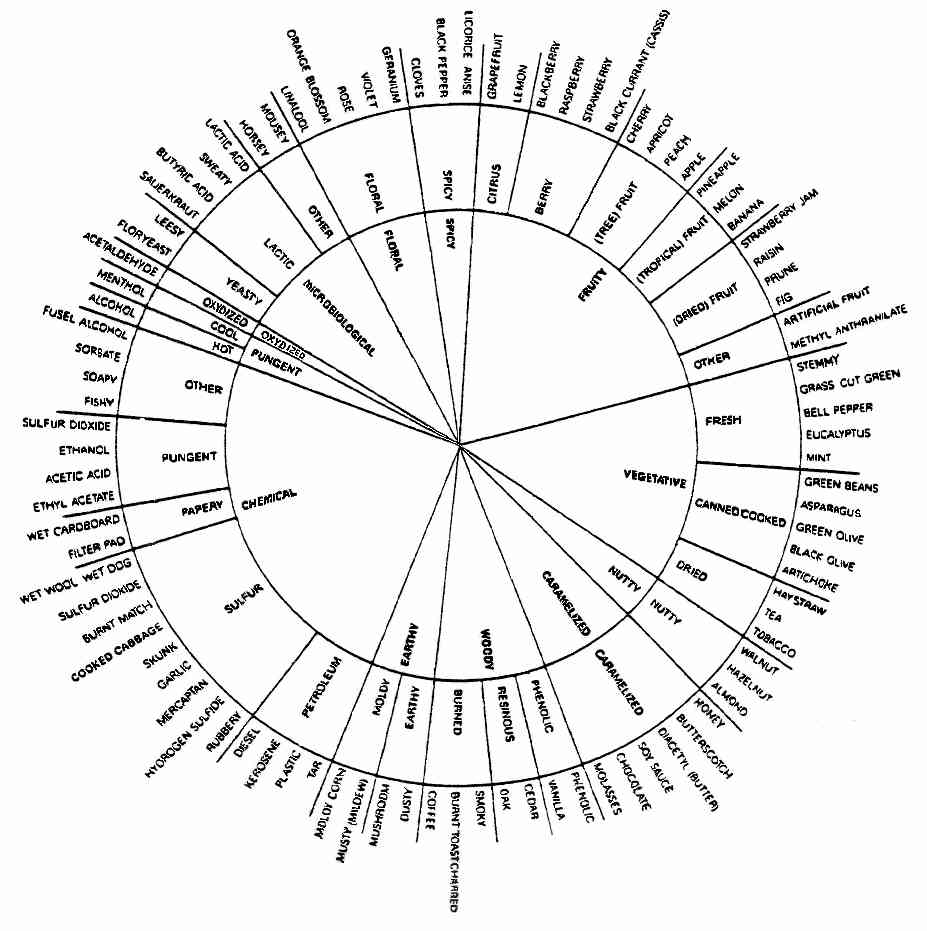
The wine club is sort of like a book club, for wines. Each meeting has a theme tying the wines together, last night's was Barbera. The meeting featured blind pourings, followed by scored evaluations of appearance, aroma, taste, aftertaste and an overall score. The score cards included the infamous flavor wheel and provided some guidance for the uninitiated. After all that there's a reveal and people's scores are added up. Then people finish the remaining wine and can compare and discuss the wines tasted.

After starting out conservative with my scores, I started to come into my own and identify things I did and did not enjoy in the wines. The biggest help was tasting several Barbera wines in quick succession. It allowed for comparison and interpretation of their differences that wouldn't be possible if those tastings were spread out over several evenings or interspersed with other varietals. I also enjoyed the effort all the participants made to avoid talking about the scoring until after the wines had been tasted. It forced tasters to dig down and try and place the flavors that were present in the wine. This was especially noticeable when one of the participants blurted out canned green beans and for the rest of the tasting that's all I could get out of that one Barbera. I'll chalk that up to either the power of suggestion or the fact that she did nail the flavor.

Since Sara and I enjoyed the experience, we're signing up for more and hope to try to do it once a month. Hopefully we'll gain a little education in wine and develop our tastes along the way.

Sunday, December 27, 2009

2009 Syrah - Day 63 - Racking

Having a little extra labor around as a result of the holidays, it seemed like an excellent chance to rack the Syrah. I was hoping to take advantage of the cold late-December temperatures to drop the tartaric acid crystals from solution in the wine. Unfortunately rushing out of my parent's house on Christmas Day, I forgot to grab my siphon and carboy and as a result was a few key pieces of equipment short of what we needed for an efficient and effective racking. So as soon as the brew store in Sacramento opened the day after Christmas I was there with Spencer and Matt to get what we needed. This delay let it warm up into the the 50s, so the temperature was probably too warm to pull the tartaric crystals out. Guess we'll need to be a little more on point next time we rack the wine.

With a new carboy and small diameter siphon in hand we set to racking the wine. As this was our first endeavor that we didn't have an easy siphon, we struggled to find a sanitary way to get siphon started without the ease of a one-way valve.

Basically it was amateur hour of us trying different ways to get enough liquid in the tube to get the siphon started. We tried everything from using a straw to get it started to crinking the hose and pumping. All to no avail. The siphon refused to get started well enough for gravity to take over. Finally we went back to the book we'd been referencing and reread the racking section.

We basically settled on you can't start the siphon without some amount of cross contamination (if you're lacking a one-way valve). The book recommended using your mouth to start the siphon and then treating the transferred wine with a dose of sulfites to kill any contaminants. I wasn't particularly happy with this solution, but nothing better was presenting itself so we went for it.

After we got the siphon going it was just a matter of waiting for the smaller diameter tube to drain each of the carboys. It took awhile for the 38 gallons to pass through the small diameter tube of the siphon. That worked out OK, since we only had one extra carboy and it gave us enough a gap between steps to clean the lees out of the most recently emptied carboy, sanitize it and then measure and dilute the sulfites before we needed to start filling the new carboy without losing our siphon.

Another thing we made a conscious effort to do was to aerate the wine. Racking it the one time it is a good thing to have the wine exposed to air. A little bit of oxygen helps to kick into gear that last remaining yeast so they can burn through the remnants of sugar that might have made it through the secondary fermentation. It also gives the malolactic bacteria a little bit of a nudge, since the wine is oxygen poor after all the biological activity that's been taking place in it. After this racking, one of the main goals of the vintner is to protect the wine from exposure to air and light. These can damage the wine. One way to minimize exposure to air it to make sure the wine is filled all the way to the neck of the carboys. This gives the surface of the wine a minimal exposure to the air and thus minimizes the oxidation of the wine.

We also tried to minimize our wine lost during each racking by tipping the carboys on their side as the siphon was drawing near the bottom. This does stir up a little bit of the lees, but it also allows the siphon to capture a little more of the wine that would otherwise be left on the lees and dumped out on the lawn. It doesn't disturb the lees too much as it tends to be a heavier sludge than the wine we were trying to siphon.

Most sources say you expect to lose about 10% of your volume during the first racking. This may seem like a lot, but it's the price you pay for clean and clear wine. This batch ended up only losing about 2.5 gallons (out of 38 siphoned), a little less than the amount expected. I'd like to chalk that up to careful siphoning, but we may have also pulled a little bit more yeast than is ideal into the next round of aging the wine. Only time will tell.

The wine tasted good. The malolactic fermentation was further along than the Cabernet. This was a surprise since the Syrah was stored in a much colder environment than the Cab (my garage for the Syrah, Luke's closet for the Cab). The colder temperature is supposed to inhibit the bacteria's progress and growth. Unfortunately the dose of sulfides likely arrested the malolactic fermentation by killing all the bacteria that we inoculated the wine with. That will need to be something we need to pay attention to the next time we rack the wine. The secondary fermentation tasted like it was close to done, if not completely finished. We didn't put a sample through the hydrometer, but I will probably try to do it next weekend so that we can have a few hard numbers to work with, same probably should be true for an acid titration. It's been since primary fermentation that we've looked at those numbers and an update on the progress would give us a look into the progress the wine has made. There was a little carbonation in the wine too, though not as much as in the Cabernet. Other than that the wine tasted good, but it definitely needs a bit more time for the flavors to develop and to clarify further. I'm thinking the next racking should be two or three months down the line, but we will see.

Thursday, December 17, 2009

Cabernet Sauvignon - Day 68-ish - First Racking

Last night we finally got around to doing our first racking on the small batch of Cabernet Sauvignon that Mr. Sauer was kind enough to get started while I was out of the country in late September and early October. After a few weeks in his garage and a few more weeks in his hall closet it was time to get the wine off the yeast and other sediments that didn't get pressed out two months ago (has it really been that long?).

The first step in racking (after the obligatory sanitizing of every instrument and surface that will contact the wine) is to siphon the wine from the container its been in to the container where it will do the next leg of its journey. For us, this was from one 6.5 gallon carboy to another 6.5 gallon carboy. Nothing too revolutionary here. We used my easy siphon that employs a one-way valve and two different diameter tubes to get a siphon going without too much effort. This beats risking of contamination by sucking on the line at the bottom of the siphon until gravity takes over.

Once the siphon gets going there really isn't much to do other than keep the siphon's intake away from the yeast and other sediments that have settled to the bottom of the carboy. This mostly leads to sitting around holding the siphon's neck. Good excuse to work on the bottle of wine we opened with dinner, try and come up with New Years plans and catch up on our idle chatter.

Once the wine starts getting down towards the bottom of the carboy a little more attention is required. The goal is to leave as little of the wine as possible on the lees, but also to transfer as little of the lees into the new carboy as possible. This is where a little more focus on the part of the racker is required. The racker needs to keep the siphon intake out of the yeast and sediment at the bottom of the wine's old container (the "lees" of the wine), but also keep the siphon intake in the liquid since if it starts slurping air, the siphon's integrity can be broken and the air bubbles could bring it all to a halt. Not stopping the siphon is especially important, since when you near the end there often isn't enough liquid to restart the siphon without sucking up a significant amount of sludge that's settled to the bottom of the carboy.

This tension between quality and quantity of the finished wine is a delicate balance. Almost any vintner is reluctant to see wine abandoned and wasted by being left behind on the lees, but careful attention needs to be paid to not carrying over too much of the yeast and the flavors the lees will impart if it remains on the wine too long. A little tip of the carboy we're siphoning out of won't disturb too much of the settled yeast, but will allow us to capture more of the wine that is near the bottom of the carboy. Though it's really a judgment call how close a vintner wants to "scrape the bottom of the barrel" to keep from wasting wine.

After the siphon transferred as much of the wine as we were able, we were left with a little bit of waste product and more room in the fresh carboy than is ideal. Since we want to minimize the surface area of the wine exposed to air as a means to minimize oxidation we needed to fill the carboy to the neck. There are a few different means of accomplishing this when there is a gap after racking. One is to fill the new carboy with some medium that will raise the volume of the liquid so the wine fills the carboy to the neck. This could be accomplished with glass marbles or possibly oak chips/balls/staves. Oak products should be closely monitored, since they will affect the finished flavor of the wine and can result in an over-oaked flavor if the wine isn't taken off the oak when it reaches the desired flavor. As we had neither oak chip nor marbles handy we opted for increasing the volume of the wine with some off the shelf Cab from the liquor store across the street from Luke's house. Not ideal, but with the limited options at 10:30 last night, it was our best solution.

We no longer can call our wine exclusively Napa Valley (we ended up adding 750 ml's of an Australian Cab and a California Cab), but we did eliminate this air gap, so that it will be ready to undergo the next leg of the racking process with risking oxidation of the wine.

Finally we did manage to taste a bit of the wine. The malolactic fermentation had mellowed some of the acid taste in the wine, but there was still a long way to go. The malolactic fermentation is something we'll need to closely monitor during the next racking or two to ensure that it finishes its work on the wine. The secondary fermentation had also left some residual carbon dioxide in the wine. You could definitely taste/feel the pinprick of bubbles in the wine. This mild carbonation should slowly dissipate. The goal is to have it all gone before we bottle. This carbon dioxide isn't all bad. As the wine slowly off-gases the carbon dioxide, it maintains a blanket of the gas over the surface of the wine. This layer of gas acts as a natural protection for the wine preventing wild microorganisms from colonizing the wine. When we no longer taste or feel the CO2 bubbles it will probably be necessary for us to protect our wine with another small dose of sulfites to keep it from getting contaminated. Overall, so far so good and our wine is well on its way to being a bottle-able finished product.

Monday, December 14, 2009

Sources of Knowledge

I'd like to imagine that the viticulture and enology coursework I did as an undergrad was a valuable part of my present knowledge base in wine making. Alas, most of the wine classes I took at UC Davis were very wide brushstrokes and left me with little practical knowledge or experience. Some of the upper level courses may have alleviated this distance, but my inability to pass organic chemistry prevented me from proving or disproving this hypothesis.

Instead my current wine making knowledge comes from more readily accessible sources. Specifically a book uncovered by Luke has been the source of most of my knowledge and my go-to reference for this wine making endeavor. The Way to Make Wine: How to Craft Superb Table Wines at Home by Sheridan Warrick has been an invaluable resource to helping us get through our first two batches of wine. It's straightforward approach to wine making goes a long way towards pulling away the veil of mystery that shrouded the art. The chapters are well organized and warn you of the various perils and issues you will run into along the way. The book is thankfully equipped with a good index, which is a vital tool when you might read through a process and then need to relearn how to do a specific step months later. The book is also thankfully written with beginners in mind and definitions are included and explained. I can't recommend the book enough as a resource for the first time vintner or someone who has a little more to learn about wine making.

Friday, December 11, 2009

Syrah - Day 47 - Finished Cutting the Template

After a lot of trimming and shaving down all the burs, repair tape and fragile letters I've finished cutting out the template for our "labels." Nothing too dramatic. Now we just need a can of spray paint to test out the label and see if it's going to do the job and if the scotch taped sections are going to hold. I'm also considering doing a second stencil that would go behind the first one and add another level of complexity to the operation/design. Any ideas on what the stencil could depict?

Or should we stick with the less labor intensive approach? I'm always a fan of not having to paint our 200 bottles twice.

Thursday, December 3, 2009

How to move a precious 6.5 Gal of Wine?

Looks like I will be moving at the end of the month which leaves me with an important question...how do you move a fragile and very full 6.5 gal carboy containing your precious Cabernet? It took all of my concentration and strength to bring the damn thing from the garage to my closet upsatirs...a cross-town move might prove interesting.

Wednesday, December 2, 2009

Syrah - Day 38 - Label Stencil Cutting

Made a little progress on the stencil for our wine bottle labels this week. Went shopping for some stencil supplies. Couldn't find the plastic that's recommended for screen print stencils, so went with some quilt pattern making supplies (mostly because it's the only flexible plastic I could find). Not ideal, the material is a little thicker than it needs to be and is designed to be cut with scissors, not a knife blade. This has complicated the cutting out of the stencil, since more force is required to punch through the plastic with the razor blade. The markings on the plastic help make it easy to line everything up and will make using the stencil easier since ensuring the stencil is straight on the bottle is as easy as lining up the marks on the back side.

My first attempt to print the stencil design directly onto the plastic sheet didn't dry-out and ended up being a smeary mess that needed to be wiped off. After that failure I opted to print out an image of the stencil and tape the plastic for the stencil over the image and cut through the plastic onto the image. The going's been slow, but I'm working on being careful and trying to get all the little plastic shards and shavings that the exactoblade leaves behind. I did have one part of the stencil that broke during cutting. I patched it up with scotch tape and am optimistic that will holdup. We'll see if that's true after I finish the stencil and do a couple test paints.

The stencil still isn't finished yet. Though one good tip I picked up was to start in the intricate cuts in the middle, since as you work your way out the stencil becomes more delicate as the supporting pieces are cut away. Starting in those spots allows you to manhandle the delicate parts a little more without fear they will come apart. Still a little ways to go. Hopefully I'll finish it up Monday or Tuesday next week. Then comes the opportunity to play with spray paint.

I still have 4 more sheets so if this one doesn't work out, I can do a few more attempts before I need to head back to the store. I'm also interested in maybe making a few different designs, either ones that can be overlaid/underlain with the one I am currently making or that can be used one their own to give us a few more label options.

Wednesday, November 25, 2009

Syrah - Day 31 - Collecting Bottles

Just a quick reminder that even though bottling is still several months away, it's never too early to start collecting and saving bottles. Especially with holiday gatherings, there should be several opportunities over the next several months to bank up enough bottles to save buying cases of empty bottles when it comes time to encase our own wine in glass.

A few things to be aware of:
Save only bottles that are corked. Screwtop bottles have a different diameter neck and can't be stopped with a standard size cork. Just recycle screwtopped bottles. Champagne and sparkling wine bottles can accept a normal wine cork, so save these, they can also be stopped with a bottle cap, this makes these bottles useful for both beer and wine. Capped champagne bottles are great for doing ongoing tests or tastings as the wine matures without using an entire bottle, as you probably would if the sample bottle were corked.

Clear wine bottles are not as desirable. They let in light, which can damage the wine's flavor as it ages. Clear wine bottles are better for white wines or wines that will be drank without much aging. Our Syrah that is still undergoing secondary fermentation should be expected to age for longer than a clear bottle would make advisable.

Also remember to keep wine case boxes as you collect bottles. The bottles will need to be stored and transferred, both before and after they are filled with wine. It's no fun shuttling around bottles an armload at a time. Save your cardboard cases.

Wash the bottles you save soon after finishing their contents. As I learned from bottling several batches of homebrew beer: bottling is already a labor intensive project, don't complicate it by requiring a thorough wash and rinse of every bottle before sanitizing. It's pretty disgusting and time consuming to wash hundreds of bottles to clean out the little bit of bacteria and mold that inevitably grow on the dregs left in the bottle. It's much easier and significantly less gross to rinse the bottle two or three times right after emptying it of its initial contents.

For the record we will need in the neighborhood of 200 bottles to hold 38 gallons of finished wine. Time to start saving.

Sunday, November 22, 2009

Syrah - Day 28 - Secondary Fermentation

Secondary fermentation is still underway for our Syrah. The airlocks still gurgle to release carbon dioxide every so often as the remaining yeast churn through the residual sugar in the wine. With the temperature dropping, biological activity in the wine is slowing down, the secondary fermentation probably will still take several more weeks due to the cool temperatures. The malolactic fermentation is also ongoing, though this does not generate the outward signs the yeast's fermentation does. The malolactic fermentation will likely continue until to first racking and even possibly beyond, depending on how slowly the temperature causes the bacteria to work.

Another passive process that's going on is the settling out of the sediments in the wine. These sediments are composed of dirt from the vineyard, yeast cells, grape pulp, grapes skins and other particles in the wine that weren't filtered out when we pressed the must. By letting the wine sit undisturbed for weeks at a time, these particles slowly succumb to gravity and settle out of solution at the bottom of the carboy. After weeks or months of quietly accumulating the sediments at the bottom of the carboys, we will be able to separate them from the wine in the process called racking. This process involves siphoning off the wine while leaving as much of the sediment as possible behind. The other goal in the racking process is to leave as little as possible of the wine behind with the sediments.

The settling and racking process will be repeated a few times over the coming months. We can also assist the process by adding agents that will attract the particles and help them settle to the bottom. This will allow us to have as clear a wine as our patience and continued rackings will yield. Racking often also minimizes the flavors of the sediments from carrying through to the finished wine.

If one of the rackings occurs during especially cold conditions it will also allow us to remove the tartaric crystals from the wine, since these acid crystals come out of solution in the wine at low temperatures. These crystals appear similar to broken glass and are considered undesirable in the finished wine. They can occasionally be found at the bottom of bottles of wine or in the last pour from a bottle. Hopefully for both the wine and the coming snow sport season, the temperature will drop to freezing and allow us to remove the tartaric crystals during one of our upcoming rackings.

Speaking of racking, the batch Cabernet Sauvignon we did prior to the Syrah should be almost due to rack for the first time, we might need to hop on that...

Sunday, November 15, 2009

Syrah - Day 21 - Malolactic Innoculation

Despite the large emphasis we have been putting on sanitation up to this point, not all bacteria are bad for wine. There are some bacteria that have positive effects on wine. One such bacteria that is often used in wine making is Oenococcus oeni, or the bacteria responsible for malolactic fermentation.

This bacteria changes the harsh malic acid present in the wine into lactic acid. This transformation reduces the bitterness of the wine, changing sour apple flavors into smoother buttery flavors and adds to the wine's fruitiness. It also slightly raises the pH of the wine, since lactic acid is a weaker acid than malic acid.

Not all wine should undergo malolactic fermentation. Almost all red wines benefit from it, but some light varietals of white wine lose their crisp edge when the acids are reduced. Generally these are Pinot Gris, Sauvignon Blanc and German whites that suffer at the hands (flagellum?) of the bacteria. Those light wines are also unable to mask some of the other flavors created by the bacteria, such as diactyls that get tucked under the rug in most red wines.

Timing of the malolactic fermentation is debatable. There are a few vintners that add malolactic bacteria at the same time as the yeast, there are a few problems with this approach. If you add the malolactic bacteria at such an early stage in the wine making process, you severely hamper your ability to use sulfites to prevent unwanted bacteria from taking hold, since the sulfites would kill the malolactic bacteria alongside any undesirable microorganisms. Another danger of adding the malolactic bacteria too early is it can start competing with the yeast for sugars and then use those sugars to create acetate acid or the main ingredient in vinegar. Generally, from the sources I've read, you want to start the malolactic fermentation around when the sugar in the must/wine is near zero. This can be at the end of primary fermentation, during secondary fermentation or even after the first or second racking.

For our batch of Syrah, the malolactic fermentation is being started 8 days into the secondary fermentation. This is based somewhat on convenience and somewhat on the need to do malolactic fermentation before the temperature gets too cold for the bacteria to survive (With a 40 F morning today, that may be too late. Seeing as O. oeni thrive at roughly the same conditions as yeast [60-80 F]).

In order to inoculate some carboys with malolactic bacteria, first sanitize the measuring dish. Then calculate the amount of freeze dried Oenococcus oeni needed to add to each carboy: Our 2.5 g package was meant for a 66 gallon batch, that breaks that down into .12 grams of freeze dried bacteria for 5 gallons; .7 for the three gallon carboy; and trace amounts to the three 750 ml bottles. Then it is a simple matter of weighing the bacteria dosage and adding it to each of the carboys. Once added, it quickly dissolves and (hopefully) sets about its business. Ideally the cold won't put an undue stress on the bacteria and malolactic fermentation gets underway soon in our wine.

Friday, November 13, 2009

Syrah - Day 20 - Label Design

We're still many months away from bottling our wine, but it's never too early to start doing the design work for our label. Based on the little experience I have from bottling beer, paper labels can be a headache. In the past I've tried labels that can be fed through a laser printer and can be applied to surfaces like a sticker (such as the Avery brand labels). They are great when you are starting with new, clean bottles. But by the time the bottle comes back for a second use, the sticker become a problem. The sticker part is a little too effective and requires a lot of scrubbing and soaking to get off the bottle. On a single bottle this isn't necessarily a problem, but increase the scale a hundred fold and your talking about an all day project of cleaning bottles so you can use them again. Many of my beer bottles retain several layers of stickum and tattered label from various previous bottlings, not ideal. In order to avoid this headache we're exploring other options for labeling.

This time around, I'm planning on trying out a different approach of labeling bottles. Inspired by the Rouge Brewery Bottles, I am trying to design a stencil that would be easy to paint onto the bottles (read: not too many layers), but would still be interesting.

The other ideas I had for it would that there was a large enough section on the label that the particular details of the wine could be written on with a grease pen or other non-permanent writing. This would allow us to reuse the bottles, but still be able to distinguish different vintages, varietals or other differences in the wine. Especially since we are producing two different varietals this year and could further complicate the matter with opting to age some of each of the batches on oak, blend some portion of the batches together, blend oak aged with non-oak aged or other combinations as we get inspired.

So for the rough draft of the wine label, I created this 15-minute-mock-up for the stencil, via Microsoft Paint (note, the black portions are what would be cut out of the stencil and therefore painted onto the wine bottle):

Still needs some work. One advantage of a stencil over a printed label, is I can make up for lack of abilities as a digital graphic artist later on when I turn the computer printout into a cardboard or plastic stencil. So those rough edges will be getting smoothed out either by someone else on a computer or by me in analog.

Slightly more interesting than the standard, default label for home winemakers: masking tape.

Monday, November 9, 2009

Syrah - Day 13 - Pressing the Must

Pressing the wine is quite a flurry of activity after mostly just waiting around for the must to ferment its sugar away. After only doing a few punch downs a day and enough tests to keep abreast of where the wine is in its primary fermentation, it's time for some action. Specifically, it's time to remove the wine (you finally get to call it wine), from the seeds, skins, stems and other detritus from the vineyard that made it into the must. This is accomplished by use of a wine press.

A basket press has not advanced much from previous generations of winemaking. It's basically a wooden big sieve that allows you to apply pressure to the contents. There are more modern options out there such as a bladder press, but for a batch of 400 pounds, that's overkill, plus half the fun of using a press is trying to figure out how to operate the mechanism and taking long enough to enjoy a few beers with your friends.

The basket press works when you start placing the contents of your fermentation tanks into it. A majority of the wine freely runs out of the press. The skins that are left behind still retain lots of wine, so once the press is full of the seeds, skins and whatever else (referred to as pomace), you start to press the contents. The key for pressing is not to press too hard. If too much pressure is applied that seeds crack or break, the wine will pick up too many sharp tannins and taste harsh. The press is designed to get as much of the wine as possible, but not press so hard as to crush the seeds and extract the undesirable tannins.


After the pommace's been pressed once it's called "the cake." The cake is a relatively solid block of skins seeds and grape pulp. However there are still portions to the interior of the cake that retain some wine, so you should stir up the contents and give them another squeeze. You're applying the same amount of force, but your attempting to get the grapes that, for-whatever-reason, didn't have all of the liquid squeezed out, another chance to contribute their wine to the final product. This is where a bladder press really shines, since all of the pomace is squeezed directly against the sieve portion of the press, the pressing process requires fewer time-consuming stirs and represses.

After the wine has been separated from the must, it's time to store it in airtight containers. Carboys are our choice. They are nonreactive, so they won't alter the flavor of the wine like plastic can do. Many vintners go with oak barrels, but seeing as we're relatively new at this and oak barrels are expensive, we're going with glass. Plus if we decide later on that we need to oak our Syrah, we can add oak chips, blocks, staves or balls to our wine and achieve close to the same effect at a much lower cost. Plus there is also the danger of over oaking the wine, which leads to the flavors of the fruit being overshadowed by the flavors of the oak. Oak barrels are also not airtight, they slowly evaporate wine, and therefor need to be regularly topped off. If the barrels of wine are allowed to get too low, the wine can oxidize.

Ideally each carboy should be filled to its neck. This creates the minimum amount of surface area for air to oxidize the wine. Just be aware there needs to be some airspace, since a little more fermentation still needs to occur.

Transferring the wine into the carboys is a pretty straight-forward affair. Capture the wine as it comes out of the press into a bucket and then dump the bucket into the carboy.


The sieve that we have in the funnel is a back up to the

press. It catches many of the particles that we will try and rack out of the wine in the coming months making it so we, hopefully, lose slightly less wine during each rack. Just be sure to clean the sieve when it stops draining well, nobody likes to see their wine spilling from the funnel onto the ground.

Once the last drop of wine has been squeezed out it's time to cleanup and get the wine stowed away. A thorough hose out of the press is necessary if you aspire to avoid the cleaning fee from the brew store renting the press. Be sure to get all the individual slats of the press and all the little corners that grape skins inevitably linger.

Finally, it's time to reward ourselves with Mexican. And don't forget to snag a taste of your wine. It's always good to remind yourself what all the time, labor and expense are for. Plus it's a good way to track the progress of your wine as it ages and under goes further fermentation. Nouveau wines are a worth a festival in many European countries, you might as well have your own private version with the freshest wine you'll ever taste as you clean up. Just don't have too much, the wine's flavor is only going to improve from here, as long as you do things right.

All that's left is ensuring you have the right space to age your wine. Air, heat and light are the enemies of wine. Air oxidizes the wine and gives bacteria the environment they need to survive and possibly flourish. Light will break down many of the desirable flavors you are hoping to develop in your wine and also provide bacteria with a better environment to grow. Notice how most wines sold in the store come in dark brown or green bottles. The reason behind that is prevent light damage to the finished product. Heat also breaks down flavors, it also can help bacteria grown if it's too warm. On the flip side, if it's too cold, the yeast can get killed before it finished the secondary fermentation or the (good) malolactic bacteria before it can break down the harsher acid flavors (though after secondary fermentation is complete, there are some good reasons to chill your wine). My garage is a little on the cold side, but we will be monitoring the temperature and make adjustment as needed.

Data on the must at time of pressing:
32 gallon: 1 Brix, 65 degrees F
20 gallon: .5 Brix, 64 degrees F
5 gallon: .25 Brix, 61 degrees F